Can You Repair a Driveway That Has Cracks, Dips and Standing Water?
Cracks, sunken sections and pools of standing water are some of the clearest indications that a driveway needs attention. While these problems may initially appear to be separate surface defects, they can sometimes be connected to movement or weaknesses within the construction beneath the driveway.
For property owners in Great Yarmouth, Norfolk, a driveway showing several forms of deterioration can often be repaired, but the correct solution depends on what is causing the damage. Localised defects may only require targeted work, whereas widespread movement or poor levels may mean that more substantial resurfacing or reconstruction should be considered.
Why Do Driveway Cracks Develop?
Cracking can occur for several reasons, and identifying the cause is more important than simply filling the visible opening.
Possible contributing factors include:
- Long-term vehicle use
- Movement beneath the surface
- Localised settlement
- Ageing surfacing materials
- Weaknesses in the underlying construction
- Water entering existing defects
- Deterioration around previous repairs
- Poorly supported edges
A single isolated crack on an otherwise stable driveway may be relatively straightforward to address. Numerous cracks appearing across different areas can suggest that the problem extends beyond the surface.
Are All Driveway Cracks Serious?
Not necessarily.
The pattern and extent of the cracking provide useful clues about the condition of the driveway.
A small localised defect may simply require repair if the surrounding surface remains stable. However, cracks that repeatedly return after previous repairs, spread across large sections or occur alongside sinking deserve closer investigation.
Repairing the crack itself will achieve little in the long term if the material underneath continues moving.
What Causes Dips and Sunken Areas?
A driveway develops a dip when part of the surface settles below the surrounding level.
This can happen when supporting material beneath the driveway compacts unevenly or loses stability. Repeated vehicle loading can make the difference increasingly noticeable.
Sunken areas may be particularly common where vehicles regularly park, turn or follow the same route across the driveway.
The important question is whether the problem affects only the surface or whether the foundation underneath has moved.
Why Simply Filling a Dip May Not Be Enough
Adding material to a low area can make the surface appear level again, but it does not necessarily address why the depression developed.
If unstable material remains beneath the repaired section, further movement may occur.
A professional driveway repair should therefore consider the supporting construction as well as the visible surface.
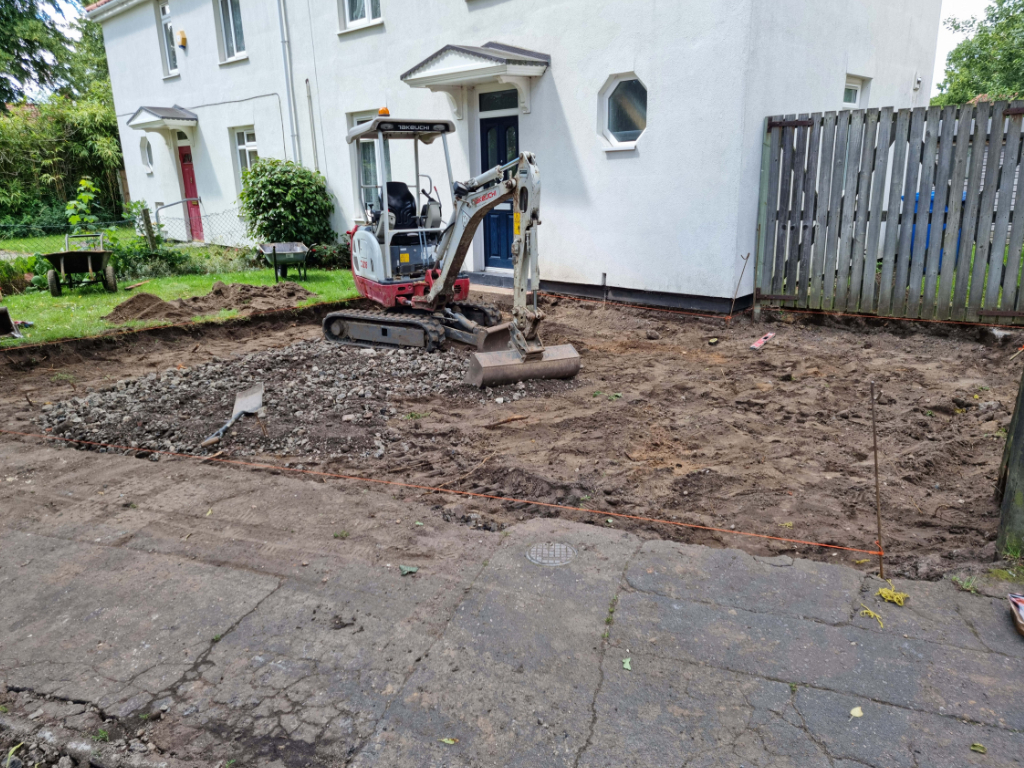
Where necessary, an affected section can be opened up so that unsuitable or unstable material can be addressed before the surface is reinstated.
What Causes Standing Water on a Driveway?
Standing water generally develops because rainfall is reaching an area from which it cannot drain effectively.
Common reasons can include:
- Localised settlement
- Incorrect surface falls
- Uneven sections
- Deterioration around drainage points
- Changes in the driveway over time
- Previous repairs altering surface levels
A small puddle may seem like little more than an inconvenience, but recurring standing water is useful evidence that the levels or drainage of the driveway need attention.
Cracks, Dips and Standing Water Can Be Connected
When all three problems appear on the same driveway, it is important to consider whether they share an underlying cause.
For example, if part of the supporting base settles, the surface above may develop a depression. That movement can contribute to cracking, while the resulting low area begins collecting rainfall.
In this situation, filling the cracks and ignoring the dip would not provide a complete repair.
The driveway needs to be assessed as a complete construction rather than treating each visible symptom independently.
When Can Localised Repairs Work?
Targeted driveway repairs can be effective where deterioration is limited to specific sections.
This may be appropriate when:
- Cracking is confined to a small area
- Only one section has settled
- The wider driveway remains stable
- Surrounding surfacing is in serviceable condition
- The underlying problem can be corrected locally
- Drainage remains effective across most of the driveway
Repairing only the areas that genuinely need attention can preserve serviceable sections of the existing surface.
When Does Resurfacing Become Worth Considering?
If the foundation remains generally sound but the visible surface has deteriorated extensively, resurfacing may provide a more comprehensive solution than numerous individual repairs.
A driveway covered with minor defects can eventually become visually inconsistent when each problem is addressed separately.
Resurfacing may be considered where there is widespread surface wear, numerous minor cracks or an ageing finish, provided the construction beneath is suitable to support the renewed surface.
A professional assessment is essential because resurfacing an unstable driveway can simply conceal deeper problems temporarily.
When Might Reconstruction Be Necessary?
More substantial work may be appropriate where deterioration originates within the driveway’s supporting layers.
Warning signs can include:
- Widespread sinking
- Significant unevenness
- Recurring cracks
- Several areas of standing water
- Previous repairs repeatedly failing
- Movement across multiple sections
In these circumstances, affected areas may need to be excavated so that the underlying construction can be corrected.
The objective is to create suitable support before reinstating the finished driveway surface.
Why the Sub-Base Matters
A driveway needs a stable foundation capable of supporting regular vehicle loads.
The sub-base helps distribute those loads and provides consistent support for the layers above. If it is poorly compacted, inadequate or has become unstable in particular areas, the visible surface may begin to reflect those weaknesses.
This can lead to depressions, movement and cracking.
Correcting foundation problems can therefore be far more important than simply making the top of the driveway look smooth again.
Drainage Needs to Be Part of the Repair
If standing water is one of the problems, drainage and surface levels should be considered as part of the repair process.
Correcting a sunken area without considering where rainfall should travel could leave another drainage problem elsewhere.
A professional assessment should examine how water moves across the driveway and whether the existing falls remain suitable.
This allows repairs to address the practical performance of the surface rather than only improving its appearance.
Pay Attention to Repeated Repairs
Previous repairs can provide valuable information about why a driveway is deteriorating.
One historic repair is not necessarily concerning. However, if the same sections repeatedly crack or sink, the problem may originate below the repaired surface.
Similarly, if new defects continually appear alongside older repair areas, the wider driveway may be experiencing progressive deterioration.
At this stage, a more comprehensive approach can sometimes be more appropriate than continuing to treat individual symptoms.
Driveway Edges Should Also Be Inspected
Damage does not always begin in the centre of a driveway.
Edges can become vulnerable where vehicles regularly pass close to them or where surrounding ground provides inadequate support.
Once an edge begins moving or breaking down, deterioration can gradually extend into adjoining areas.
Professional inspection should therefore consider the complete driveway, including borders and transitions, rather than focusing solely on the most visible crack or puddle.
Why Early Attention Is Worthwhile
Small defects can influence surrounding sections if they are allowed to deteriorate.
Cracks can widen, depressions may become deeper and low areas can collect increasing amounts of rainfall.
Addressing the problem while deterioration remains localised may provide more repair options.
The key is to establish the cause early rather than repeatedly treating the surface without understanding what is happening underneath.
Should You Repair or Replace the Driveway?
There is no single answer based solely on the presence of cracks, dips or standing water.
The decision depends on:
- How much of the driveway is affected
- Whether the underlying base remains stable
- The extent of settlement
- The condition of the existing surface
- Whether drainage can be corrected locally
- How previous repairs have performed
- Whether defects are isolated or widespread
A driveway with several visible problems may still be repairable. Equally, seemingly modest defects can sometimes reveal more extensive weaknesses once the construction is assessed.
Why Professional Assessment Makes a Difference
Successful driveway repair starts with diagnosis.
At Great Yarmouth Driveways, we provide professional driveway services throughout Great Yarmouth, Norfolk. When an existing surface develops cracks, dips or drainage problems, the objective is to determine why those defects have occurred before deciding on the appropriate work.
Where deterioration is localised, targeted repairs may restore the affected areas. Where the surface is extensively worn but the supporting construction remains suitable, resurfacing may be considered. If the underlying foundation has deteriorated, more substantial reconstruction may be required.
Taking this approach helps ensure that attention is directed towards the cause of the problem rather than simply disguising its visible symptoms.
Conclusion
A driveway with cracks, dips and standing water can often be repaired, but the correct solution depends on what is happening beneath the visible surface. Localised cracking may need relatively focused attention, while sinking and recurring standing water can indicate problems with levels, drainage or the supporting construction.
When several defects appear together, they should be assessed as part of the same driveway rather than treated independently. Correcting the underlying cause provides a much stronger basis for a dependable repair.
For property owners in Great Yarmouth, Norfolk, Great Yarmouth Driveways can assess damaged and uneven driveway surfaces and determine whether targeted repairs, resurfacing or more extensive work is appropriate. If your driveway is cracking, sinking or regularly holding water, arranging a professional assessment can help identify the cause and the most suitable way to restore the surface.
Call us on: 01493 807 282
Click here to find out more about Great Yarmouth Driveways
Click here to complete our contact form and see how we can help with your driveways.